UK Casino Loyalty Rewards Compared: What the Points Actually Buy in 2026

Updated July 2026
Licensed
Available in US
Fast payouts
18+ Only
UK Casino Loyalty Rewards Compared: What the Points Actually Buy in 2026
Last updated: Reading time: 9 min

Why loyalty schemes look different in 2026

A friend who runs CRM at a mid-tier operator told me last November that her team had cut loyalty reward budgets by 22% for the coming financial year. She did not need to explain why. The Remote Gaming Duty rise from 21% to 40% from April 2026 wiped out most of the surplus that funded generous comp point conversion rates, and the UK loyalty landscape adjusted accordingly. The schemes that survived the cull are the ones doing the most work with the smallest budgets.

UK online slots generated £773 million in GGY in Q1 2026, with 4.8 million active accounts. A typical loyalty programme today is funded by a sliver of that GGY — and the operators who failed to ringfence the budget before duty hit are visibly leaner on reward conversion rates than they were 18 months ago.

UK casino CRM manager reviewing the loyalty programme budget allocation on a workstation

How loyalty schemes actually work behind the scenes

Every UK casino loyalty programme reduces to the same three variables. First: how many comp points does a player earn per pound wagered? Second: at what rate do those points convert back to cash, free spins or bonus credit? Third: how do tier benefits change the first two numbers? Once you know those three figures for any scheme, you can compare them honestly. Everything else is presentation.

The standard structure for a UK slot loyalty programme in 2026 is one point per £10 wagered on slots, half that on table games, and a conversion rate that floats between 100 and 500 points per £1 of reward. That gives an effective rebate of between 0.2% and 1% of wagered amount at the entry tier, climbing to 1.5% to 3% at the top VIP levels. Anything advertised as offering more than 3% rebate at any tier is either using a different definition of “wagered” or is genuinely an outlier.

The variation worth comparing is in eligibility weighting. Slots usually count fully, but live dealer wagering counts 25% to 50%, blackjack and roulette can count as low as 10%, and video poker is frequently excluded entirely from earning points. The headline rate matters less than the weighted rate across the games a player actually plays.

UK casino loyalty programme earning rate comparison across slots, live dealer and table games

Tier benefits, separated from marketing fluff

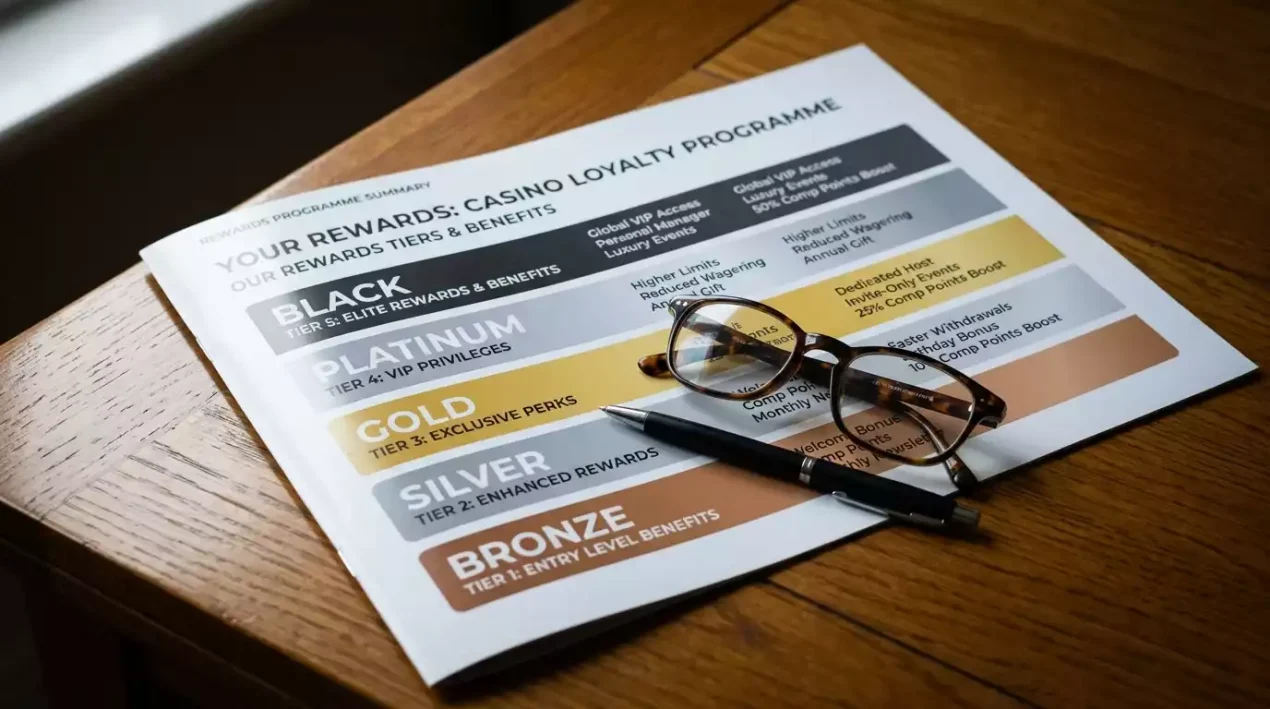
I rank tier benefits by category, not by name. A “Diamond Elite” tier with a metallic icon does not mean more than a numbered tier 5. The substance comes in five real benefits: improved point conversion, faster withdrawals, dedicated account management, exclusive game previews, and bespoke promotions.

Of those five, only two move the financial needle. Improved point conversion is the obvious one — a top-tier rebate of 2% versus an entry-level 0.5% is a four-fold value increase on every pound staked. Faster withdrawals matter only if the base withdrawal time is unacceptable; an operator that pays out in two hours at entry level and one hour at VIP is offering a marginal improvement, while one that pays out in five days at entry and same-day at VIP is using slow base service as a VIP carrot. That second pattern has not disappeared from the UK market, and it deserves to.

Dedicated account management is the benefit most likely to be misused. A VIP manager who only ever offers reload bonuses and reactivation incentives is not adding value — they are a CRM channel with a friendly name. A genuine account manager handles disputes faster, escalates technical issues, and respects responsible gambling boundaries set by the player. The line is visible when you push it. Ask a VIP manager to lower your deposit limit. If they hesitate or try to negotiate, the scheme is built on extraction, not loyalty.

UK casino VIP tier benefit summary cards stacked side by side for direct comparison

Cashback as the simpler alternative

A loyalty programme with twelve tiers, six earning rates and a points shop is a more elaborate way of doing what a simple cashback offer does cleanly: returning a percentage of net loss to the player. The cashback model has gained ground in the UK precisely because it is comparable across operators in a way that comp point schemes are not. For the wider mechanics of how cashback works alongside or instead of points-based loyalty, see the UK cashback casinos breakdown.

The interesting development of 2026 is hybrid programmes: small points-based earning rates for engagement, paired with a weekly or monthly cashback floor that gives a guaranteed minimum return. Players I trust prefer this structure because it cuts through the opacity of comp point conversion. You know what your floor is; the points are a bonus on top.

One side note on tier downgrades. UKGC operators are required to disclose how a player can lose tier status, and the rules vary widely. Some schemes drop a tier after 30 days of inactivity, some after 90, and some maintain tier status for a calendar year regardless of activity. The 30-day downgrade clauses are a soft form of pressure: they nudge a VIP back into play during gaps that might otherwise be self-imposed cooling-off periods. Players who use breaks as part of their bankroll discipline should check that policy before they commit to chasing a tier.

Hybrid weekly cashback floor combined with loyalty points dashboard on a UK casino account

The wagering requirement most schemes do not advertise

Every loyalty reward in the UK carries an implicit wagering requirement, even when none is stated. The act of earning the points already required wagered turnover. The act of converting them to bonus credit often requires further wagering on the converted bonus. The act of withdrawing winnings from that bonus may require a further multiplier.

Concrete example: at one point conversion rate of 500 points per £1 of bonus credit on a scheme paying 1 point per £10 wagered, the player has wagered £5,000 to earn £1 of bonus credit. If that £1 of bonus credit then requires 35x wagering before withdrawal, the player wagers a further £35 to potentially convert it to cash. The headline rebate rate of 0.2% is technically accurate; the effective rebate after all conditions can be a quarter of that. The scheme is not lying; it is just relying on players not running the full calculation.

Genuine rebate programmes — where the comp points convert directly to cash with no further wagering — exist, but they are a minority of the UK market. I rate them higher than equivalent bonus credit schemes by a meaningful margin, because the cash conversion is the difference between a quoted rebate and a real one.

Worked example calculating effective rebate from a UK casino loyalty programme on a paper worksheet

The duty backdrop reshaping loyalty budgets

The Remote Gaming Duty change from April 2026 is the single biggest pressure on loyalty programmes in a generation. With total online casino GGY at £1.4 billion per quarter in mid-2025, and 69.9% of remote casino, bingo and betting revenue coming from online casino games, the duty rise translates to hundreds of millions of pounds shifting from operator margin to Treasury revenue annually. Treasury projections suggest an extra £810 million in 2026/27 and up to £1.16 billion by 2030/31. That money has to come from somewhere, and loyalty rewards were the easiest line item to trim.

The visible effect: point conversion rates have worsened across the market, weighted eligibility on table games has tightened, and high-tier benefits have shifted away from cash equivalents toward experiences and merchandise that cost the operator less. A VIP gift of a branded watch costs the operator wholesale price; an equivalent cash rebate is a real margin hit under the new duty. Smart operators have made the shift gracefully; less smart ones have stripped value and hoped players would not notice.

Looking ahead to the rest of 2026, expect more cashback floors and fewer pure points schemes. The market is moving toward transparency because the maths now demand it. A scheme that cannot survive an honest comparison with a flat-rate cashback offer is a scheme that will not survive the next 18 months of duty-driven margin pressure.

Shelf of branded merchandise and experiential rewards offered as UK casino VIP gifts

How I choose a loyalty programme in 2026

The shortlist of criteria I keep at the top of my notebook has not changed in three years, only the weighting has. Effective weighted rebate rate sits at the top — calculate it from earning rate, conversion rate and game eligibility, not from the marketing splash. Tier maintenance rules come next — anything under 60 days of inactivity for a downgrade is too aggressive. Then point expiry: schemes where unspent points lapse within six months are extracting urgency from players.

Below those three: withdrawal speed differential between tiers (smaller is better), the structure of account management contact (proactive offers versus reactive support), and finally the actual range of items in the rewards shop. If 80% of the catalogue is bonus credit and the other 20% is merchandise that nobody wants, the scheme is not really offering choice.

Apply those filters across the UK market and the field of genuinely good loyalty programmes shrinks to a handful of operators. That is the truth the marketing copy will not tell you. Most schemes are vehicles for retention, not rebate, and the duty era has stripped the surplus that used to make them broadly worthwhile.

Analyst notebook listing loyalty programme evaluation criteria for UK casino comparison

What is a realistic effective rebate rate from a UK casino loyalty scheme?

Entry-tier weighted rebates typically deliver between 0.2% and 1% of wagered amount, climbing to 1.5% to 3% at top VIP levels. Schemes advertising more than 3% at any tier usually have hidden conversion conditions that reduce the real value.

How did the April 2026 duty rise change UK casino loyalty programmes?

With Remote Gaming Duty rising from 21% to 40%, operators tightened point conversion rates, reduced eligibility weighting on table games, and shifted high-tier rewards toward lower-cost experiences and merchandise rather than cash equivalents.

What is the difference between a cashback scheme and a loyalty programme in the UK?

Cashback returns a percentage of net loss as cash or low-wagering credit on a fixed schedule. Loyalty programmes use point accumulation across multiple tiers with conversion rates that vary by game type. Cashback is easier to compare across operators.

This material was created by the PunterLedger team.

Related posts