In-Play Betting UK: How Live Markets and Cash Out Work on British Sportsbooks
The technology layer most punters never see
In-play betting feels instantaneous to the punter. You see a chance go begging in the box, you flick to the goalscorer market, you back the striker at 4/1 in the seconds before the next phase of play. What you do not see is the trading desk behind that price, the latency between the stadium camera and your phone, the algorithmic safeguards that suspend the market the moment a corner is awarded, and the audit trail recording every micro-decision. Gambling Survey for Great Britain data shows 4–7% of UK adults bet on horse racing in any four-week window, with live in-play increasingly the format these regulars use across racing and football alike.
Live in-play is the product that converted sports betting into a continuous engagement business. The Q1 2026 Gambling Commission data showing 13.4 million monthly active online accounts is heavily weighted by people who place at least one in-play bet a month. The technology underneath this is one of the most complex pieces of consumer-facing infrastructure the UK gambling industry has built.

How in-play pricing engines actually work
A trading desk for a major football match starts the day with model prices based on team strength, recent form, head-to-head record, and contextual factors like rest days and squad availability. Those prices feed an algorithmic engine that takes positional, statistical and event-stream feeds during the match — possession, shots on target, shots in the box, dangerous attacks, expected goals (xG) accumulating in real time — and adjusts the prices several times per second.
Two systems run in parallel. The autonomous algorithmic system handles the routine micro-adjustments: a corner is awarded, the next-goal market shifts a tick towards the team in possession; a shot goes wide, the market widens slightly. The human trading desk handles the exceptions: injuries that look serious, weather changes that affect play, controversies that might lead to abandonment, betting patterns that suggest insider knowledge. The desk overrides the algorithm when context demands it.
The data feed is the underlying competitive advantage. Operators license real-time match data from Stats Perform, Sportradar, IMG and a handful of others. The quality of the feed determines the quality of the pricing. A book buying Tier-1 data with venue cameras and sensor-level event recognition can price faster and more accurately than a book using delayed broadcast feeds. The price difference between two books on the same in-play moment is often the data tier the back-end is built on.

Why bet suspensions happen, and for how long
Bet suspensions during in-play are the trading desk’s defensive mechanism. When the trader does not know whether the live price reflects current reality — because something has just happened on the pitch that the algorithm has not yet processed — the market suspends. The pause is typically 5 to 15 seconds during routine events (a goal, a red card, a penalty awarded), longer during contentious moments (VAR review, injury treatment, equipment failure).
The frustrating reality for the punter is that suspensions cluster around exactly the moments the punter most wants to bet. A near-miss on goal triggers suspension because the market needs to settle before the operator accepts more bets. By the time the market reopens, the price has moved and the opportunity is gone. This is not the operator being malicious — it is the operator protecting itself from automated arbitrage that would otherwise pick off mispriced markets in the seconds after each event.
Late goal scenarios produce the most dramatic suspensions. Stoppage time of a tight Premier League match might see the next-goal market suspended for thirty seconds at a time as the algorithm and the desk both struggle to keep up with the chaos. The operator’s reflex is conservative: when in doubt, suspend. A book that runs many concurrent matches has limited human bandwidth to manage exceptions, and suspension is the default safe action.

Cash out mechanics and where the price comes from
Cash out is the option to settle a live bet for the operator’s current valuation of it, before the underlying market resolves. A punter who backed a team at 3/1 and is winning 2-0 with twenty minutes remaining might see a cash-out offer of, say, £85 on their original £10 stake. Accepting the offer guarantees the £85 regardless of how the match ends.
The cash-out price comes from the operator’s current implied probability of the bet winning, minus the operator’s margin. If the operator thinks the bet now has a 70% chance of winning, the fair cash-out value on a £10 bet at 3/1 (where the original payout would be £40) is £28. The operator will typically offer somewhat less — perhaps £25 — to retain margin on the cash-out transaction itself. The operator’s gross profit on a cash-out is the difference between fair value and offered value.
What makes cash-out controversial is that the operator controls the price and the punter has no easy way to verify whether the price is fair. There is no published formula, no third-party benchmark, no requirement for the operator to disclose the implied probability used. The honest operators offer cash-out prices close to fair value because they want the punter to use the feature regularly. The less scrupulous operators offer cash-out prices noticeably below fair value, betting that punters will accept the offered amount because seeing a number labelled “cash out” feels safer than risking the original bet.
Partial cash-out and edit-my-bet features are extensions of the same logic. The punter can take part of the cash-out value and let the rest of the bet ride. Each operator implements these differently, with different fair-value adjustments. The punter who uses cash-out routinely should compare offered values across two or three operators on the same bet type — the differences are real and significant. The connections between in-play coverage and accumulator-heavy football betting are detailed in the way Premier League and EFL markets are priced.

Betting during live matches and how the trends are moving
Grainne Hurst’s observation that “the direction of travel is clear: regulated firms are scaling back their advertising, while the harmful black market grows rapidly” applies to in-play as much as anywhere. The advertising restrictions tightening through 2025 and 2026 affect how in-play products can be promoted, particularly during live broadcasts. The 5pm-9pm watershed rules and the broader gambling marketing code restrict what operators can run during live football coverage, which pushes promotion to in-app and on-site channels.
The Q1 2026 data showing 18% growth in session counts to 202 million but a 12% drop in long sessions over an hour matches a particular in-play behaviour pattern: punters opening the app during a match, placing one or two in-play bets, and closing the app. This is not the marathon Saturday-afternoon session of the pre-mobile era. It is brief, interruption-driven, and event-triggered. The operators that have built their in-play interfaces around quick targeted bets — rather than full coupon construction — are catching this pattern.
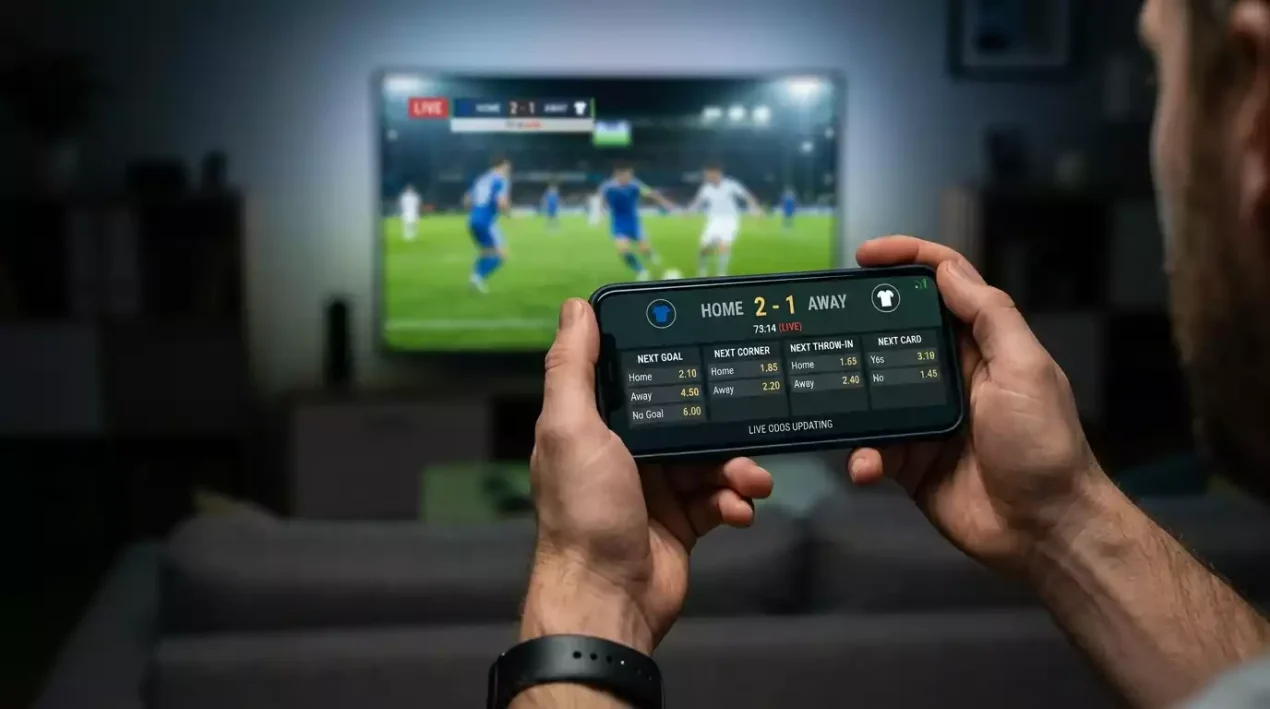
The other shift is towards short-format markets. Next goal, next throw-in, next corner, race-to-X-points in tennis. These are markets that resolve quickly and let the punter take a result, exit, and re-engage on the next decision point. The traditional full-match betting line is still the bread and butter, but the engagement growth is in the micro-markets that have proliferated since 2023.

Where in-play sits in the UK sportsbook product mix
In-play is no longer a feature; it is most punters’ default mode for football, tennis, cricket and increasingly basketball. The book that does not price in-play well in 2026 is losing customers regardless of how good its pre-match prices look. The competitive separation between sportsbooks is now visible in their live products more than in their pre-match books, which have converged on similar overround structures across the major operators.
For the punter, the practical assessment of an in-play product is: how rapid is the price update during normal play, how reasonable is the suspension behaviour during incidents, how fair are the cash-out offers compared to the implied probability, and how cleanly does the interface let me place a bet in the moment? These are subjective judgements that need testing rather than reading, and the test is to place small in-play bets across two or three operators during the same live event. The differences become obvious within a single match.

Why does cash out value sometimes drop below a fair price?
The operator controls the cash-out calculation and applies a margin to the implied probability of the bet winning. The punter sees only the offered number, not the underlying maths. Cash-out values noticeably below fair value indicate the operator is taking a wider margin on the cash-out transaction than on the original market — comparing offered values across two operators on the same bet is the only reliable way to spot this.
How long are bet suspensions during a goal-mouth incident?
Routine suspensions last 5 to 15 seconds during single events (goal, red card, penalty). VAR reviews and significant incidents extend suspensions to 30 to 60 seconds. Late-game scenarios in tight matches produce overlapping suspensions that can make markets functionally unavailable for the closing minutes. This is the operator’s standard defensive mechanism, not an unusual condition.
This material was created by the PunterLedger team.