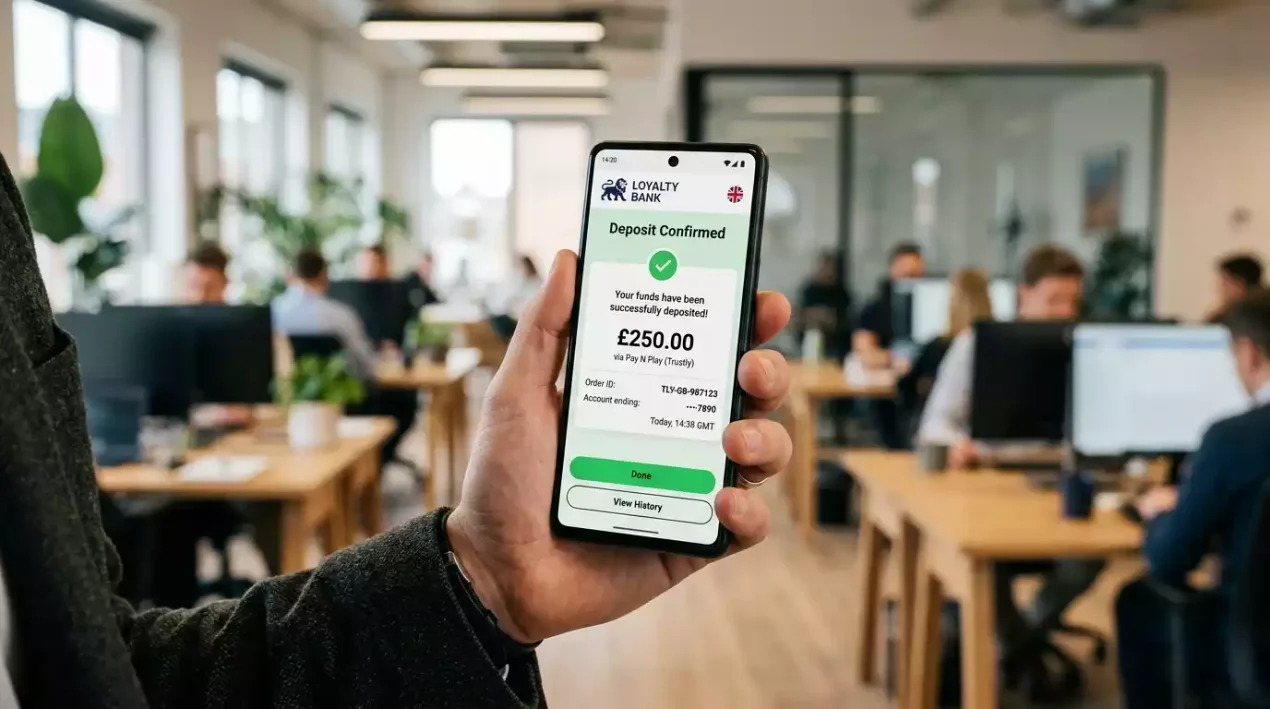
Trustly Pay N Play Casinos UK: Open Banking Deposits and Instant Cashouts in 2026
The payment rail that did not need an account
The cleanest way to understand Pay N Play is to picture what the gambling industry looked like without it. A new player landed on a casino site, created an account, set a password, entered card details, waited for the deposit to clear, played, won (or lost), and at withdrawal time had to upload identity documents and wait. Pay N Play compresses that flow to two steps: the player taps a deposit amount, logs into their bank in a redirect, and is playing inside thirty seconds. No account creation in the traditional sense. No password. No card form. The first time I saw it working, I thought it was a magic trick. The reality is that it is Open Banking doing the heavy lifting.
Trustly built the concept and remains the dominant provider, particularly in Nordic markets where the format was born. In the UK, Open Banking infrastructure under PSD2 made the same flow possible from 2018 onwards, and Trustly’s UK presence has grown steadily since. The Gambling Commission’s frictionless financial risk assessment pilot, which passes through 95% of cases without the player noticing, fits naturally into this architecture — Open Banking already knows what the operator needs to know.
What Pay N Play actually is, in plain terms
Pay N Play is the marketing name for a Trustly-provided service that combines an instant bank deposit with bank-verified identity data, allowing a casino to accept a player without a traditional registration flow. The technical flow is that the player chooses an amount, picks their UK bank from a list, is redirected to bank login (usually biometric on mobile), confirms the payment, and is returned to the casino with funds credited and an account silently created behind the scenes.

The “no account” framing is partly marketing. An account is created — the operator needs one to comply with UKGC record-keeping and AML rules — but the player does not see the friction of creating it. The bank provides the operator with verified name, address, date of birth, and account holder confirmation. That data satisfies most of the operator’s Know Your Customer obligations on its own.
Withdrawal is the other half of the story. A Pay N Play withdrawal goes back to the same bank account that funded the deposit, using Trustly’s outbound rails. On weekdays during banking hours, the funds arrive in minutes. At weekends or outside banking hours, the bank’s clearing schedule determines the wait, which can stretch to a working day.
Trustly’s UK coverage and how complete it really is
Trustly partners with the majority of UK retail banks via the Open Banking API. Coverage in 2026 includes the major high street banks, the digital challengers (Monzo, Starling, Revolut), and most of the building societies. The thin spots are smaller credit unions and some specialist account types. For a typical UK consumer with a Lloyds, Barclays, NatWest, HSBC, Santander, Nationwide, Monzo, Starling or Revolut account, Trustly works without configuration.

What varies is the bank’s UX inside the Open Banking redirect. Monzo and Starling provide a polished one-tap biometric confirmation in their mobile apps. Lloyds and Barclays push the user through web-based authentication that involves entering a passcode and selecting an account. Either flow works, but the digital banks make Pay N Play feel like the magic trick it was designed to be, while the legacy banks make it feel like a slightly slicker version of a debit card payment.
The flow degrades when the bank’s Open Banking endpoint has an outage. Trustly cannot complete the deposit if the bank’s API is down for maintenance, which happens more often than any party advertises. A casino that runs Trustly as its only deposit method (some Pay N Play purists do) faces an immediate revenue hit when a major bank has API problems. The smarter Pay N Play casinos keep card and Apple Pay alongside as fallbacks.
Where KYC and Pay N Play rub against each other
This is the part most casinos do not explain well. Open Banking gives the operator strong identity confidence, but it does not give the operator complete UKGC compliance on its own. Tim Miller’s framing at the September 2025 Peers for Gambling Reform summit was that “there will always be more to do, but my encouragement to all of those that have an interest in making gambling fair, safe and crime free is: do not allow a drive for future reforms to be at the expense of effective implementation.” Pay N Play is a useful illustration. Implementation depth matters more than the flashy front-end.

The £150 financial vulnerability check that the Gambling Commission introduced in February 2025 applies to Pay N Play accounts in exactly the same way as it applies to traditional accounts. A player whose net deposits cross £150 over a rolling 30-day window triggers the same frictionless financial risk assessment. Most of the time, Trustly’s bank data has already given the operator what the check needs, so the assessment passes silently. Occasionally it does not, and the player gets a request for additional verification that breaks the “Pay N Play” promise. The 5% of cases that involve friction inside the 95% frictionless rate are concentrated here. For full detail on how that threshold operates, see the £150 financial vulnerability threshold.
Source-of-funds checks are the other point of friction. Trustly tells the operator which bank funded the deposit, but it does not tell the operator where the bank’s funds came from. A player making large deposits via Pay N Play can still be asked for proof of income, recent payslips, or evidence of inheritance once the volume hits AML thresholds. The Pay N Play promise dissolves quickly when the operator’s compliance team flags an account for SOF review.
How fast a Pay N Play withdrawal actually clears

On a clean account that has already cleared KYC, a Trustly withdrawal during weekday banking hours arrives in minutes. I have timed cashouts at five minutes from request to bank credit on a Tuesday afternoon, which is faster than any other rail. The bank’s Open Banking endpoint pushes the credit through Faster Payments, and Faster Payments is genuinely fast.
The qualifier “on a clean account that has already cleared KYC” is doing significant work in that sentence. First-time withdrawals are slower, because the operator runs an extra layer of identity checks even when Open Banking has already provided the data. A first cashout might take 24 hours; subsequent cashouts might take five minutes. The variance between first and subsequent withdrawals is much greater on Pay N Play casinos than on traditional casinos.
Weekend and bank holiday delays still apply. Faster Payments operates 24/7, but the operator’s compliance team usually does not. A withdrawal submitted at midnight on Saturday at a Pay N Play casino sits in the queue until Monday morning even though the rail itself is open. This is operator policy rather than payment infrastructure, and players who plan around it can avoid the wait.
The trade-offs of going Pay N Play first

For a UK player choosing whether to fund a casino through Pay N Play, the practical questions are: do you bank with a Trustly-supported institution, do you want a faster registration than a traditional casino flow, and are you comfortable with the operator receiving your bank data through Open Banking. If all three are yes, Pay N Play is genuinely the best deposit experience available in the UK market. The combination of speed, accuracy, and reduced friction has no near-peer.
The trade-off is that Pay N Play does not really change the underlying obligations. The operator still needs to verify your identity beyond Open Banking when AML thresholds trigger, still applies the £150 affordability check, and still enforces deposit and stake limits the same way it would for a traditional account. The convenience is at the front end; the regulatory machinery behind the front end is unchanged. Players who expect Pay N Play to bypass UKGC oversight will be disappointed. Players who expect it to remove front-end friction will be impressed.
Does Pay N Play satisfy UKGC KYC requirements at all?
Open Banking provides the operator with bank-verified name, address, date of birth and account-holder data, which covers most of the KYC obligation. The operator still needs to apply ongoing affordability checks and source-of-funds reviews when triggered. Pay N Play handles the front-end identity step efficiently; the deeper compliance machinery sits behind it unchanged.
Which British banks integrate cleanly with Trustly deposits?
Most major UK retail banks have full Open Banking integration with Trustly in 2026. The digital challengers (Monzo, Starling, Revolut) provide the cleanest in-app authentication. Legacy high street banks (Lloyds, Barclays, NatWest, HSBC, Santander) work reliably, with a slightly heavier web-based authentication flow.
How fast is a Pay N Play withdrawal once KYC is cleared?
During UK banking hours on a weekday, a Trustly withdrawal from a clean account can arrive in the bank within minutes once the operator approves it. The first withdrawal is usually slower because of additional identity checks. Weekend and bank holiday withdrawals are delayed by operator policy rather than payment infrastructure.
This material was created by the PunterLedger team.